
Eco-travel
Published on:
Aug 28, 2026
St Lucia's Most Iconic Nature Hotel | Jade Mountain & Anse Chastanet
.png)
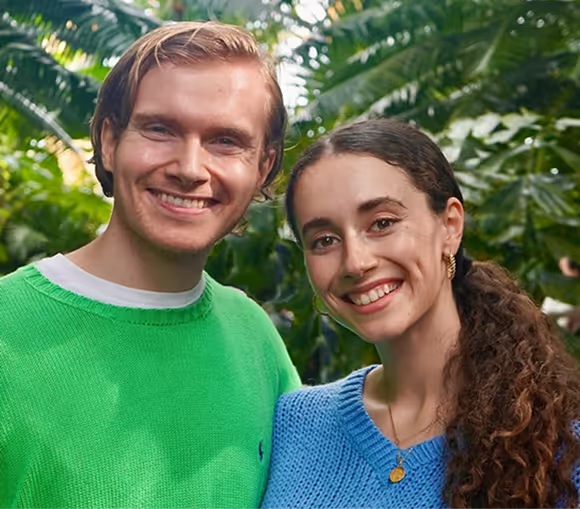
We spent a week on one of the most beautiful islands in the Caribbean—St. Lucia—and we’re not exaggerating when we say we may have just found a resort that brings the phrase ‘heaven on earth’ to life. Most hotels talk about sustainability. This one has been quietly living it for over fifty years.
Growing up in Florida, most people I knew would plan vacations to the Bahamas, the Caymans, or Puerto Rico for island getaways due to their close proximity to the state and the promise of remarkable, powder sand beaches. It wasn’t until years later that I learned about the island of St. Lucia through a friend who had just spent Christmas there with his family, and who raved about its beauty. After that conversation, it took me a few years to get there to see it for myself, but I now understand that the island of St. Lucia is home to some of the warmest people, a fascinating and turbulent history, rich biodiversity, and one of the most breathtaking views in the world.
Whether you prefer to veg out in the sun on the beach with a piña colada and a good book, or challenge yourself by conquering whatever physical activity is available to you on holiday, there’s a little bit of everything–from art classes to sailing, tennis to kayaking, diving, biking, hiking, and more–nestled on a hillside spanning 600+ acres at Anse Chastanet and Jade Mountain resort.
We touched down at Saint Lucia’s Hewanorra International Airport (UVF) on a sunny afternoon, and were almost immediately greeted by the smell of the salty ocean air and the caws of tropical birds. Hewanorra is St. Lucia’s indigenous name, originating from the peoples that inhabited the island prior to colonisation—but more on that later! The airport is also located in the southernmost part of the island where it is wider and flatter, and where the wildness of the Atlantic Ocean and the calm of the Caribbean Sea meet.
After a short wait at customs, we stepped outside the small airport to find the Anse Chastanet and Jade Mountain welcome stand, where our lovely greeter, Kurve, welcomed us to the island and hailed us our transportation to the hotel. As our driver, Emmanuel, taught us shortly after we began our 45-minute car journey, St. Lucia only has one main road that circles the edge of the island. This is to ensure that the thousands of acres of lush, biodiverse rainforest in the centre of the island remain largely untouched and intact. There are nature trails and rainforest tours that visitors can enjoy, but only with licensed tour operators that have express permission from the Saint Lucian Forestry Department.
As we wound our way along the curving road through villages whose names alternate between French and English—‘thanks’ to the centuries-long dispute over St. Lucia between England and France, whereby the island’s ‘ownership’ changed hands an astonishing 14 times (7 times French, 7 times English)—the island’s beauty struck us immediately: from the multi-coloured houses that line the streets, to the mountains that surround you as you climb higher up the road, and the fruit trees that grow wherever they can and teem with papayas, calabash, bananas, cocoa beans, and mangoes that were just preparing to ripen.
Once we reached the bustling town of Soufrière, the nearest town to the resort, on the southwestern side of the island, we could hardly believe our eyes as the UNESCO-protected Pitons came into view. Skirting a cliff edge along the steep and bumpy road leading to Anse Chastanet, we could hardly take our eyes off the landscape opening before us with crystal blue waters, small boats bobbing near the coast, and the intense green of the jungle around us.
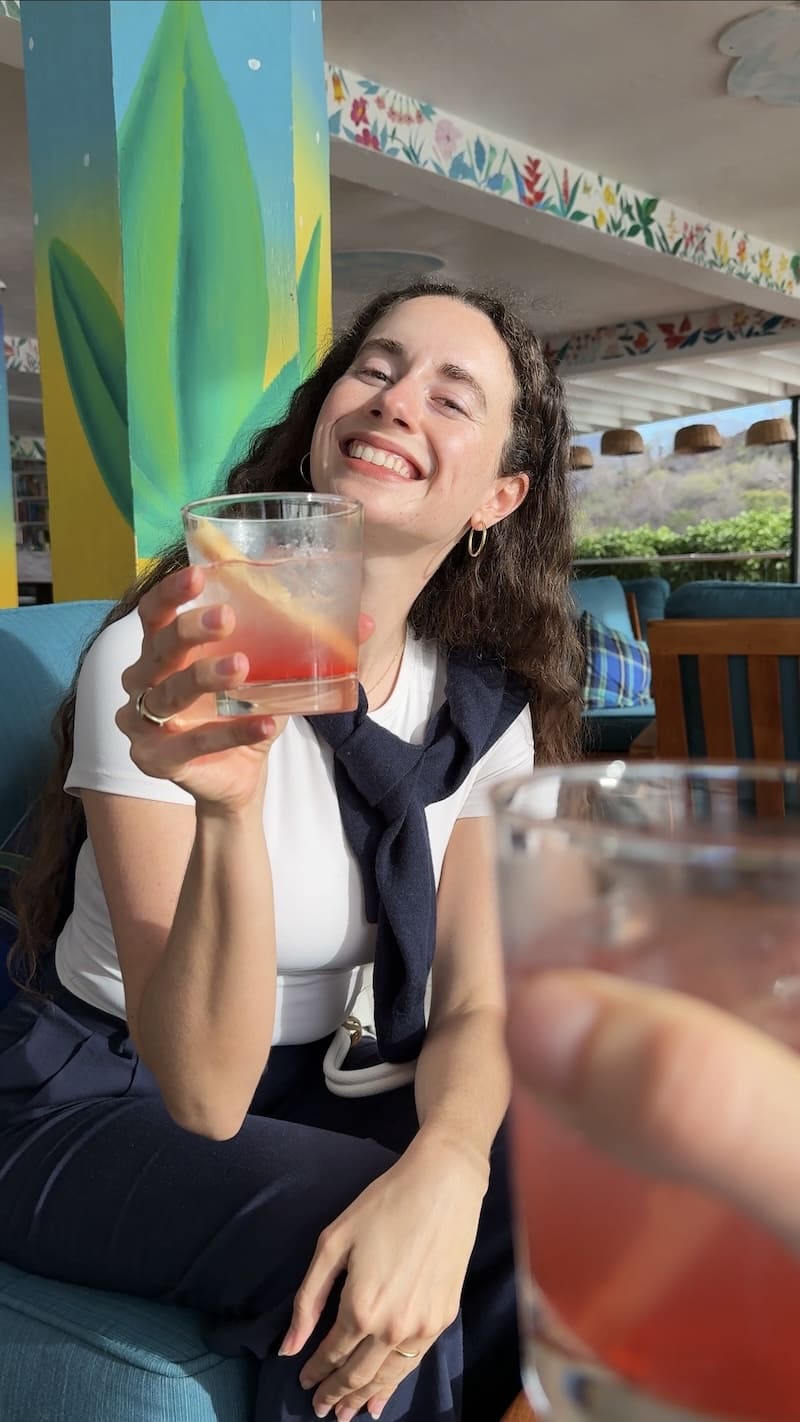
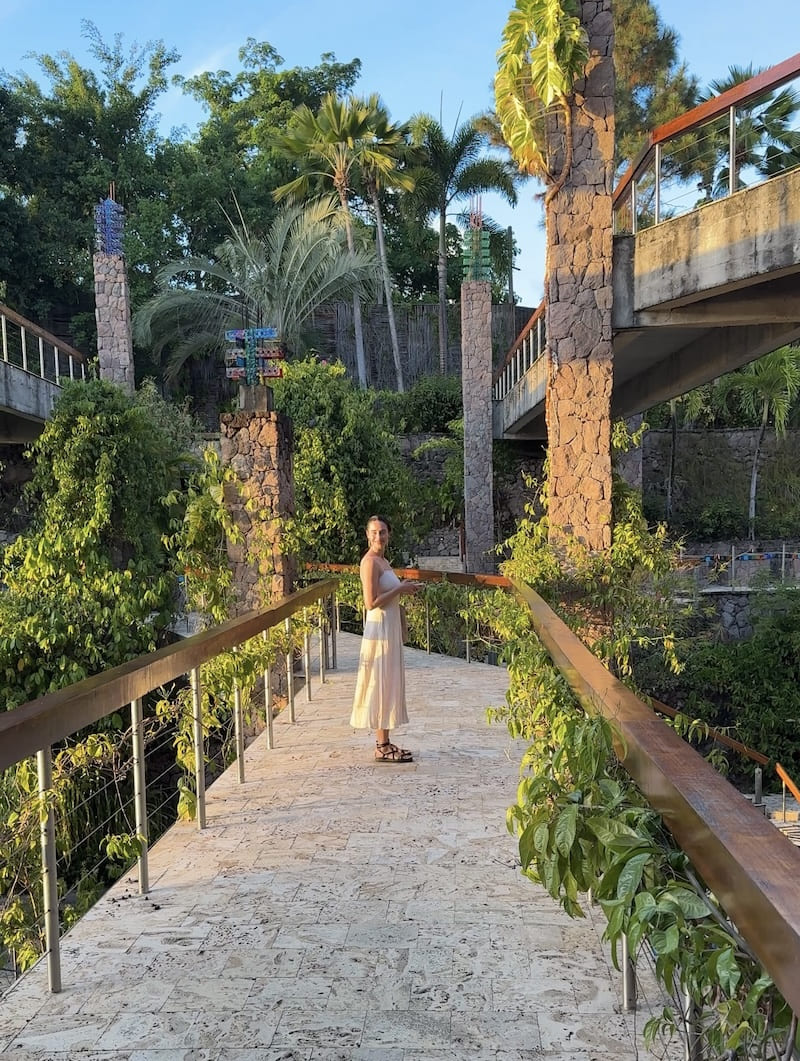
As we entered the gates of the resort, we climbed a road even steeper than before, arriving at the Anse Chastanet reception deck overlooking the sea. It’s here that we met members of the management team, Jonathan and Peter Jean-Paul, and were given a delicious sugarcane and grenadine mocktail by bartender Alain. This was the place we had heard so much about, and where we finally got to sit a moment and take in the beauty, as well as learn that every design choice made here by visionary architect and late owner Nick Troubetzkoy was intentional and meant to mirror the natural beauty around it. From the coralina stone floors that absorb water, preventing slips; to the hand-carved wooden beams that adorn every restaurant and office column on-site; and that very few places in the resort have air conditioning due to the passive ventilation design that allows the sea breeze to generously cool through the resort.
.jpeg)
.jpeg)
But what about bugs? Obviously in any tropical location, insects are an essential part of maintaining the lush ecosystem, yet as a guest staying in an open-air room, the fear of waking up and seeing mosquito bites dot your body is very understandable. Fortunately, Anse Chastanet thought of everything! All of the rooms, restaurants, and guest spaces on site are equipped with yellow lights, which bugs don’t gravitate to like they do white light, as well as mosquito nets surrounding the beds for those pesky ones that do manage to sneak into your room. Additional fans can be supplied to also maintain air flow, and bug spray is always available in the rooms, just in case.
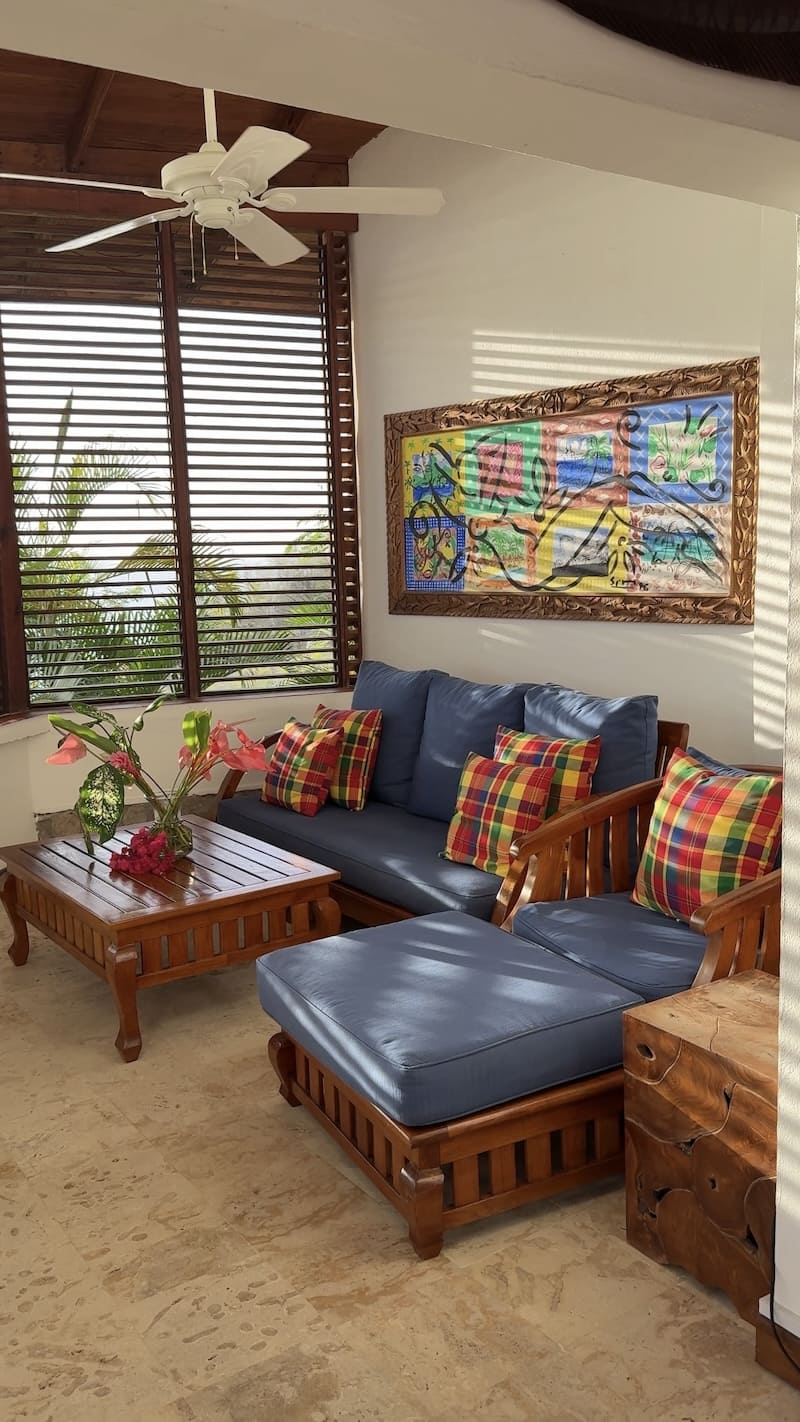
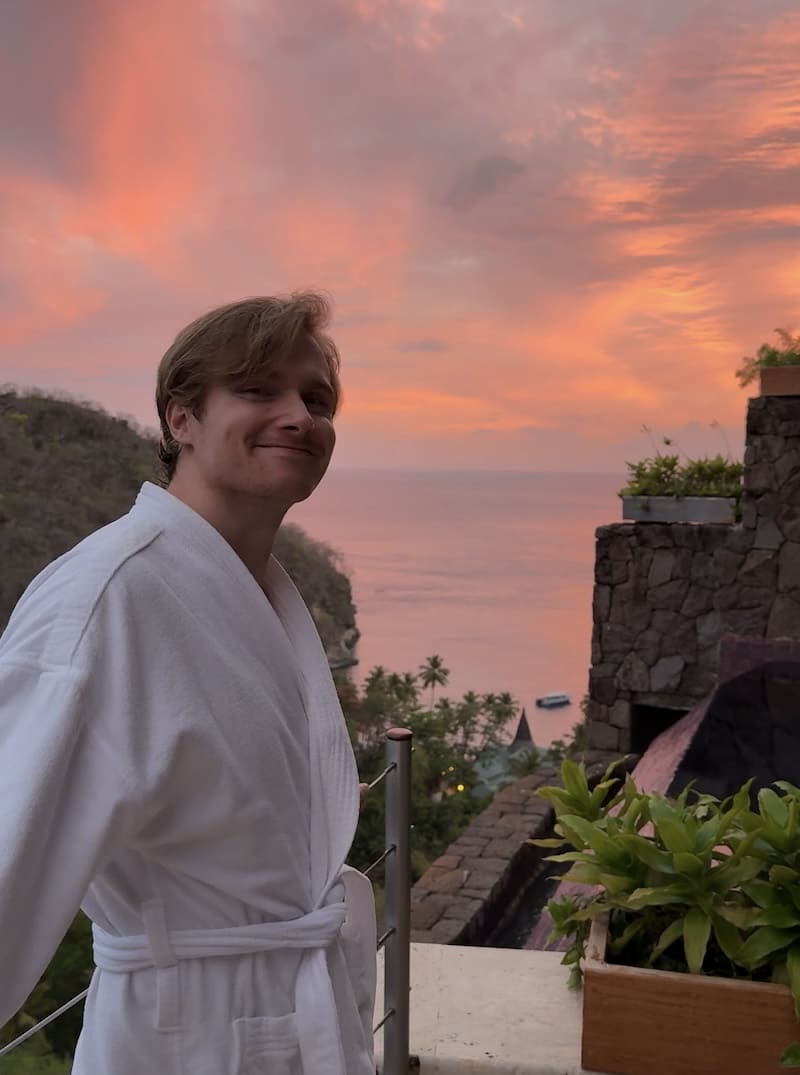
From here, we were taken a short uphill walk to our room, 7A Coralita, where we got to marvel at the simple, yet comfortable design of the room, complete with art meticulously selected by co-owner Karolin Troubetzkoy; traditional St. Lucian Madras linens and decor; and 180-degree views of both the Pitons and the sun setting just to the west. After a quick shower, we popped open the bottle of non-alcoholic bubbly the team had left for us in honour of Ben’s upcoming birthday, marvelled at the sky flicker between its different shades of orange and pink, and went down to the Treehouse Restaurant for dinner. Overlooking the canopy, the Treehouse Restaurant offers an extensive menu using local ingredients, with plenty of clearly-marked vegan and vegetarian options.
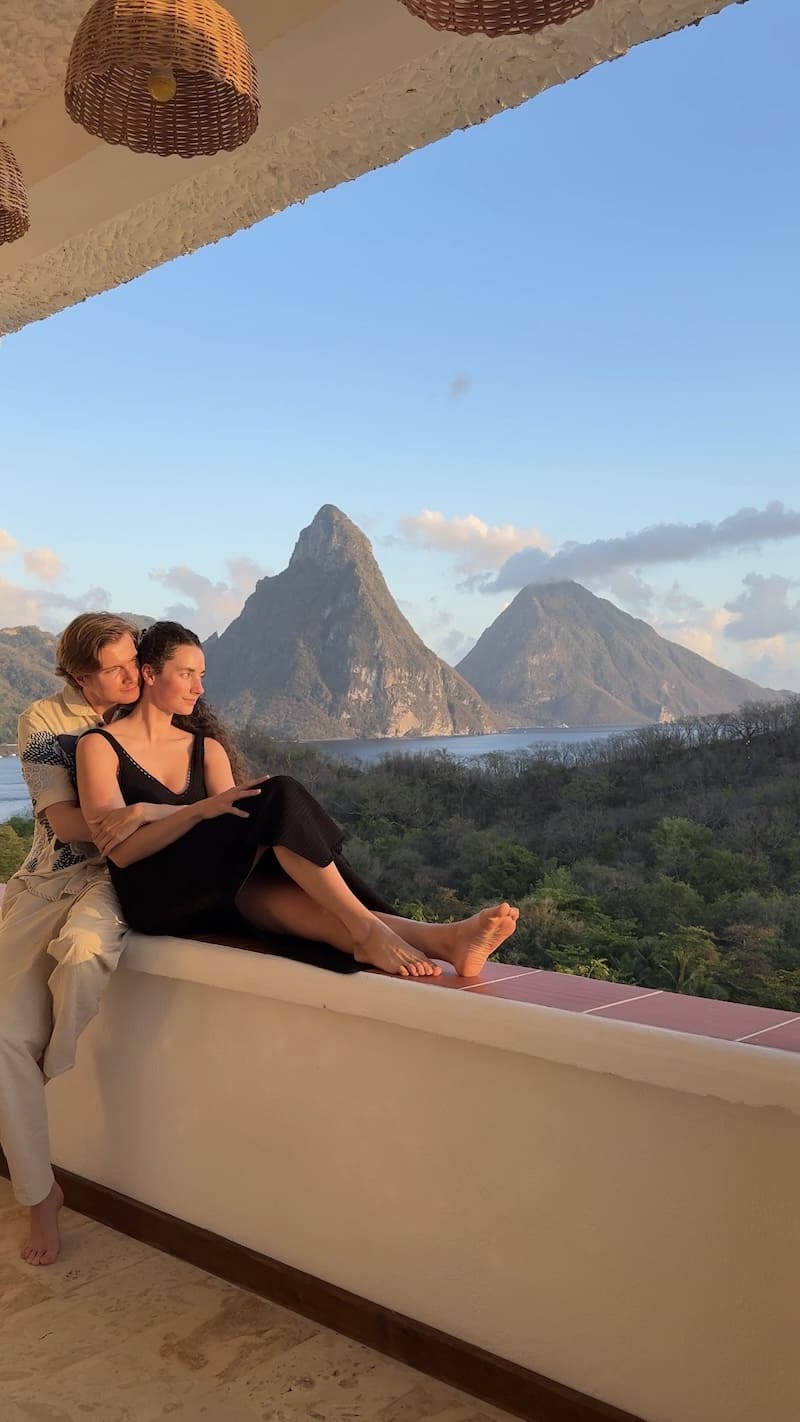
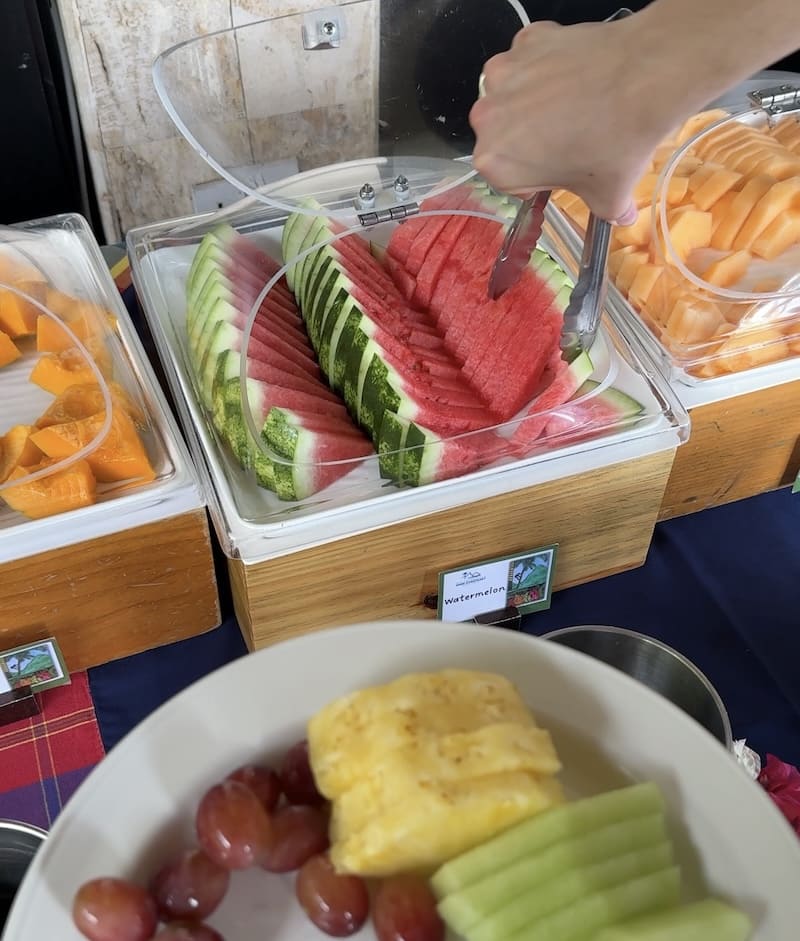
Equal parts jet-lagged and excited to start our day, we awoke at 7am, just as the sun began to spread its rays over the Pitons. We then quickly made the short walk down to the Treehouse restaurant for breakfast, where we were met by a large buffet full of fresh-picked fruits, homemade jams (like passionfruit and lychee) and breads, as well as a portion of avocado toast large enough to feed a family of four–exactly what we like!
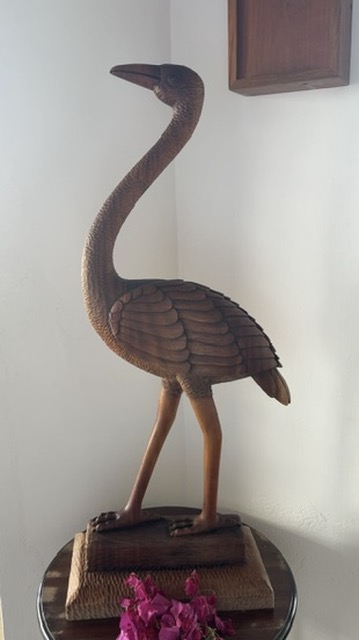
After breakfast, we went to the hotel’s library and games room, featuring books brought and exchanged by guests from all over the world, for a brief orientation tour with manager Peter Jean-Paul, who has worked at the hotel over 27 years. From sharing more about the local sculptor and master woodcarver, Lawrence Deligney, to the evolution of Anse Chastanet and Jade Mountain over the years, Peter’s quips and ever-jovial spirit guided our small group throughout the main areas of the hotel, answering all of our questions along the way. (For those who are thinking of skipping the tour, psst…there’s a tasty surprise at the end!)
.jpg)
.jpg)
.jpg)
Throughout the Caribbean, it is unmistakable and undeniable the legacy that colonialism has wrought on each island; and despite officially achieving independence from Great Britain in 1979, it’s incredibly important to understand how centuries of imperialism, extraction, and oppression steered St. Lucia to where it is today. To better understand this tangled history, we decided to take the hotel’s Creole History class, taught by none other than once again the jack-of-all trades, Mr. Peter Jean-Paul.
In about an hour and a half, we dove into the Indigenous history of the island, learning about the iguanas that used to run the island (Hewanorra actually means ‘land of the iguanas’!) before the first known peoples, the Arawaks and Caribs, arrived. Then we moved onto the alleged Spanish ‘discovery’ of the island, the struggle that ensued between the native peoples fighting for their island against the earliest European settlers, and their eventual defeat, which ushered in the centuries of tug-of-war between France and England for control of the fertile St. Lucia. It was incredibly engaging and interesting, and as it takes place on the beach rather than a stuffy classroom, we highly recommend it!
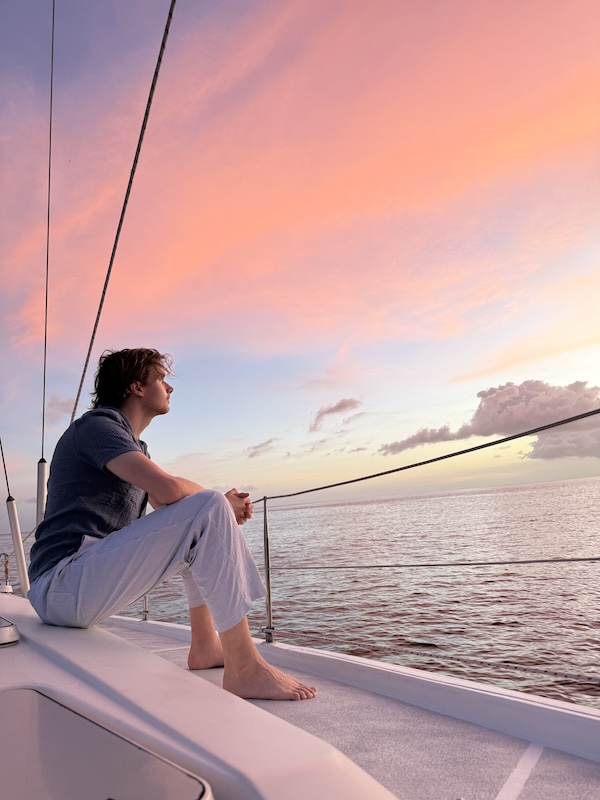
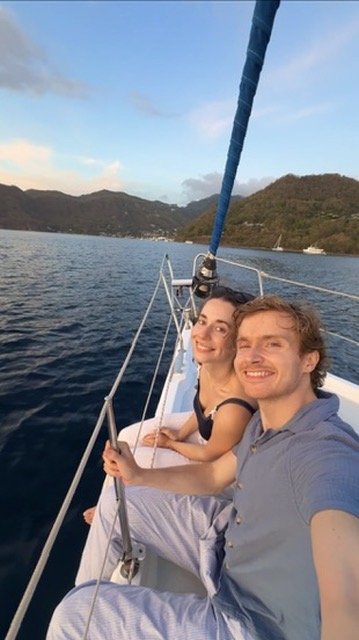
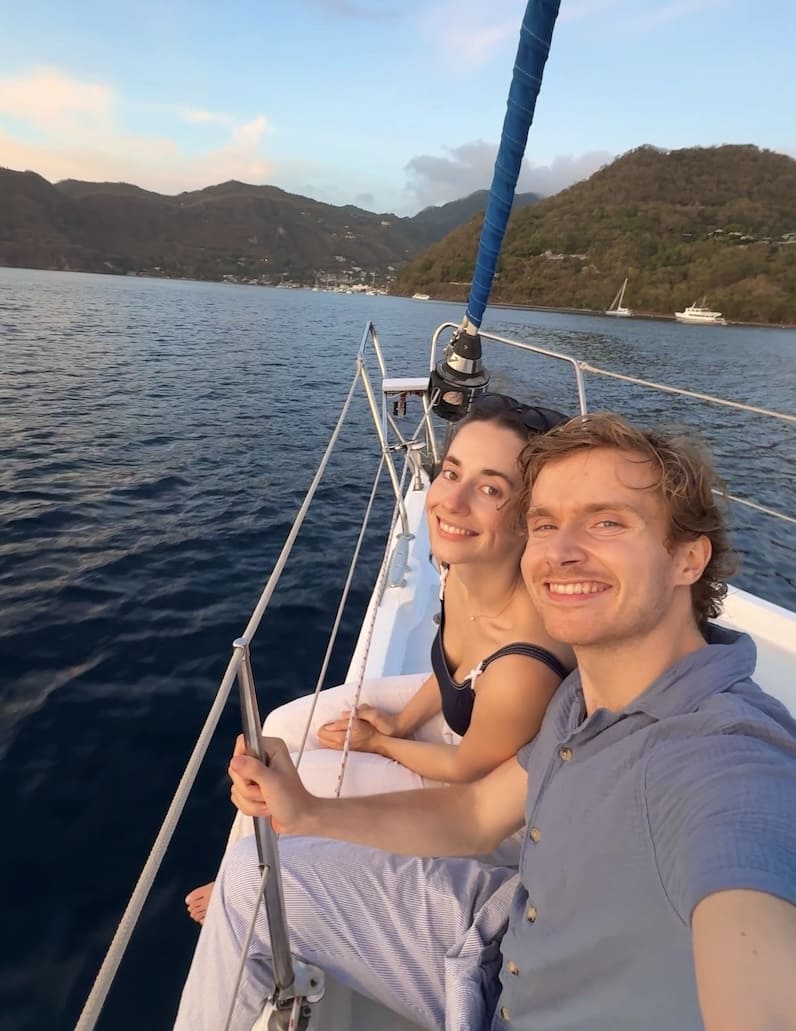
After a few hours of lying on the beach, we ran back up to our room to change, before meeting the crew behind our evening excursion–sunset sailing! Every night, a sunset sail is offered to guests, and the sailboat, Ms. Julie, can accommodate up to 8 people. We somehow got lucky, and no one else signed up so we had the sunset sail all to ourselves with the captain, Kareem, and first mate, Thaddeus.
We had just set off to go closer to the pitons when the unimaginable happened. In the distance, we could see intense splashing that definitely wasn’t just the breaking of a wave. As eagle-eyed Captain Kareem spotted first, he set off in its direction to check it out.
As we got closer, we began to see the dorsal fins of dolphins breaking the surface, but it wasn’t until we were just metres away that we realised that we were surrounded by hundreds of dolphins! Where we could see over fifty just from the surface, we knew there had to be possibly hundreds more underneath. Ben and I stood there with our mouths agape and with tears in our eyes as the dolphins jumped and played around us, with at least twenty swimming just in front of the boat, curious about us. We looped back, and once again they returned, circling our boat, and swimming on their side to look up at us, as we basically hung off the boat to get the best look at them we possibly could, and of course to send them all of our love as the setting sun turned the sky above remarkable shades of purple, pink, and blue.
.jpg)
.jpeg)
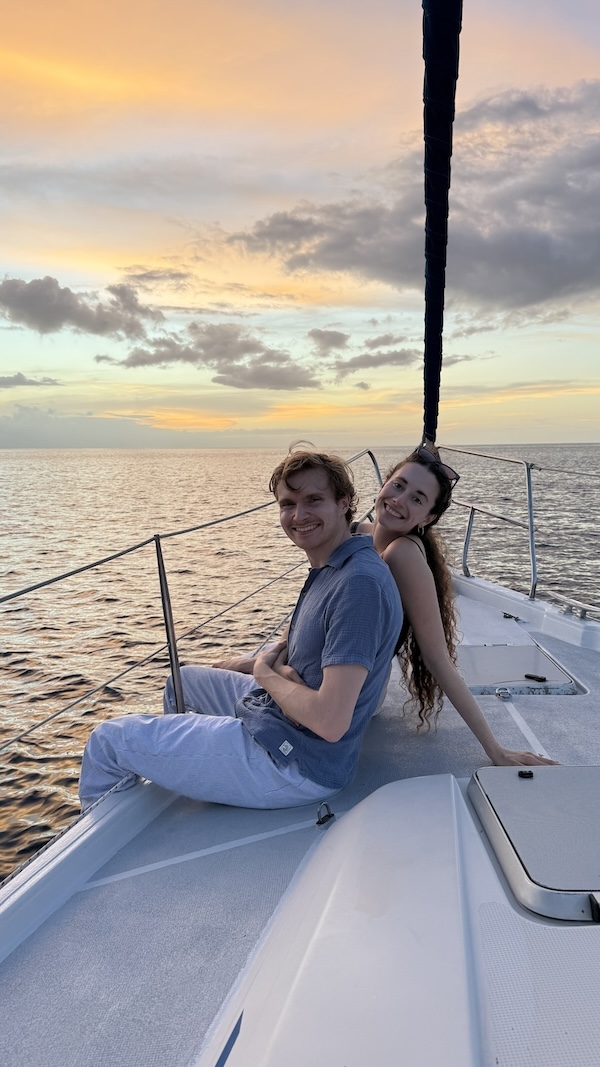
Note: Upon returning to land, we researched the dolphins we saw and believe them to be Pantropical Spotted Dolphins, as they each had similar colouring with almost a stripe of different colouring on their side and the trademark spots. If you’re a marine biologist and say otherwise, please reach out and let us know what they are!
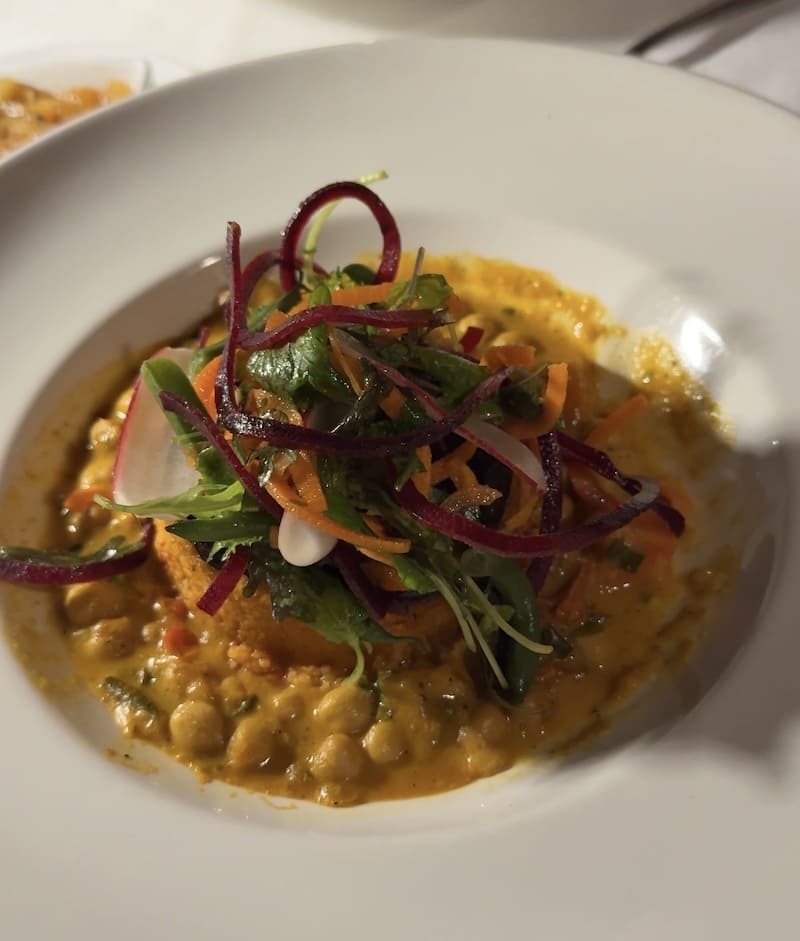
We wrapped up the seemingly unbeatable evening with dinner at Anse Chastanet’s on-site vegetarian and vegan restaurant, Emeralds. The restaurant sits right next to The Treehouse restaurant, and serves Caribbean fusion and Ital dishes made almost entirely from ingredients sourced from their own organic farm, and whose plant-based dishes can be found across the hotel.
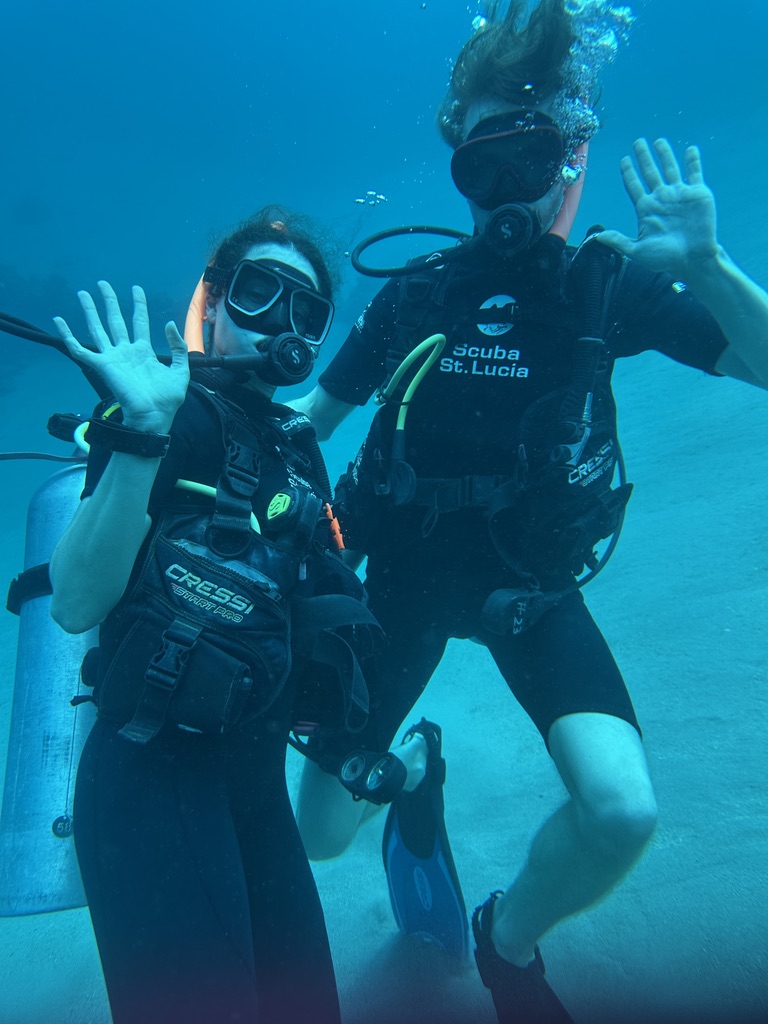
If you checked out another recent blog of ours, you saw that we recently got our PADI Open Water Diver certifications in Statia. This gift of knowing how to scuba dive not only brought us closer to nature overall, but gave us an even deeper respect for the ocean and its biodiverse beauty below the surface.
Anse Chastanet was taken over by Nick Troubetzkoy in the late 1960s, and little did he know at the time that some of the most pristine reefs (now a marine reserve) in the Caribbean were thriving just steps from the beach of his new resort. After seeing what was just off the coast, the Troubetzkoys were instrumental in making Saint Lucia a destination for scuba divers, opening one of the first PADI Five-Star dive shops in the Caribbean, and the first on the island, in 1981.
This became the catalyst that sparked a chain of events, raising marine awareness and encouraging others to preserve marine resources on Saint Lucia, including leading to the creation of both the Soufriere Marine Management Authority (SMMA) and the Saint Lucia National Conservation Fund, and the planting of in-situ coral nurseries just off shore of the resort in 2024.
Knowing that we were in not only safe hands, but also in an incredibly unique dive spot, prompted us to get in the water as soon as we could. Starting with a shore dive so that the instructors could ensure our skills were up to date, it didn’t take long for the sea floor to descend into a glorious reef, where colourful fish, lobster, invasive lionfish, and more went about their days. Soon after, we moved in the direction of Anse Chastanet’s coral nursery, where a school of barracuda stood guard over the baby corals. This was not only incredible to see up-close, but to know that Anse offers guests snorkel and dive excursions with marine biologists is a wonderful way to integrate the fun of a vacation activity with the importance of marine conservation.
.jpg)
.jpeg)
.jpeg)
Nothing makes you hungrier than a day of swimming and getting some sun, so for dinner on our third night, we checked out another of the hotel’s restaurants, Apsara, which is renowned for its East Indian Caribbean fusion cuisine–and it certainly did not disappoint!
The reach of the British Empire meant that ‘subjects’, like many people from British-occupied India, were offered ‘employment’ (indentured servitude) in different parts of the Empire. This meant that starting as early as 1845, thousands of men, women, and children were brought from India to St. Lucia to work under conditions similar to the recently-abolished slavery. The legacies of colonial policies like these are lasting, and has influenced St. Lucia’s cultural ties to East India to today–like in its fusion cuisine and in the cultural dress (e.g. wearing Madras, named for the now-named city of Chennai).
After four days in paradise at Anse Chastanet, we knew that nothing could surely make our trip better than this…until it somehow did. We rose early to pack our bags, and catch a morning boat dive group heading for a reef situated directly below the Pitons. Upon our return around eleven, we had lunch and a wonderful couple’s massage in the hotel’s Kai Belté Spa before heading back up the mountain. As we reached reception, they informed us that all of our bags had been moved for us, and that our room in their sister hotel, Jade Mountain, was ready.
We first learned about Anse Chastanet and Jade Mountain from the BBC series Amazing Hotels: Life Beyond the Lobby several years ago, when we couldn’t even dream of being able to travel to a place as spectacular as those they highlighted on the show. When we got the invite last year to come visit the resort, we could hardly believe it; yet, nothing could prepare us for what it felt like walking into our room (here called ‘sanctuaries’) at Jade Mountain for the first time.
Opened in 2006, and envisioned for years by Nick Troubetzkoy, Jade Mountain is made up of 24 sanctuaries, each open-air with just three walls to marvel at the splendour of the Pitons and a private infinity pool. All potable water on-site (in both hotels) is sourced and filtered from the property’s historic 19th-century Anse Mamin reservoir. This ensures that the hotel’s needs don’t stress the local water supply, as so often happens when island resorts are built. The south-facing rooms are large and luxurious, and truly offer not only the best views, but also the best service one could hope for.
.jpg)
.jpg)
.jpeg)
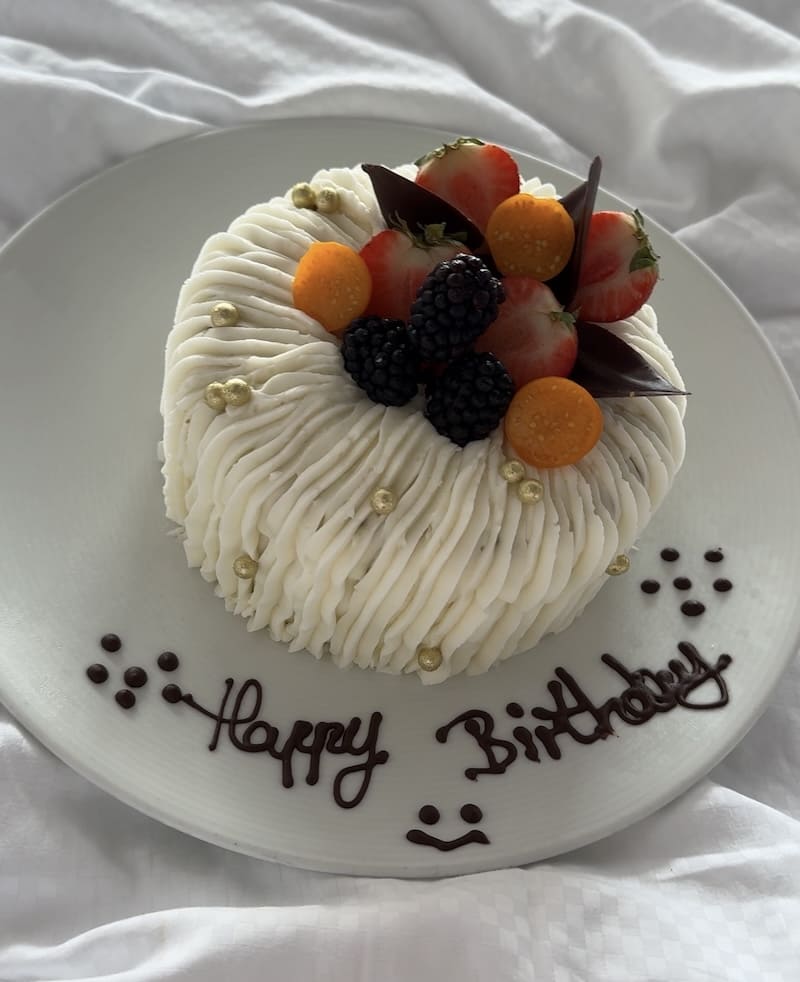
Both Anse Chastanet and Jade Mountain employ a 99% local workforce made up of some of the friendliest, funniest, and most attentive people anywhere. In Jade Mountain in particular, each room is assigned a major domo, or room manager, to accompany and accommodate any and all requests guests can make. Without us asking, they heard that it was Ben’s birthday while we were there, and our major domo, Allain, made sure to have a carrot cake (Ben’s favourite) brought to our room to celebrate the occasion early!
By dinnertime, we celebrated the Manager’s Cocktail Party on the rooftop of the Jade Mountain Club, where the managers could spend some time getting to know guests better as the sun set over the horizon, followed by dinner under the stars. With almost non-existent light pollution, our view of the stars was endless.
Today was the day Ben had been most looking forward to: the day of our Emerald Estate farm tour, chocolate-making class, and Anse Mamin plantation tour. With a packed schedule, we had vegan plantain pancakes ordered to the room with an orange blossom syrup and a large plate of fruit before setting off.
First, we hopped in a van that drove us across Soufriére to the resort’s Emerald Estate organic farm, a 27-acre stretch growing everything from string beans to herbs, to cacao, mangoes, papaya, coffee, squash, greens, bananas, decorative plants, and so much more! When we arrived, estate expert Martin showed us around, picking leaves, veggies, edible flowers, and fruit for us to guess and try along the way.
.jpg)
.jpg)
.jpg)
By the time we reached the dense tree cover that shelters cocoa beans from too much sunlight, we had nibbled our way through the estate like a couple of rabbits, and we couldn’t wait to try the fruit of the cocoa pod. Sweet and almost a little sour, the pulp of the cocoa bean can be sucked off to reveal the dry, almost crumbly cocoa interior that is then dried, roasted, and tempered to make the chocolate that we know and love.
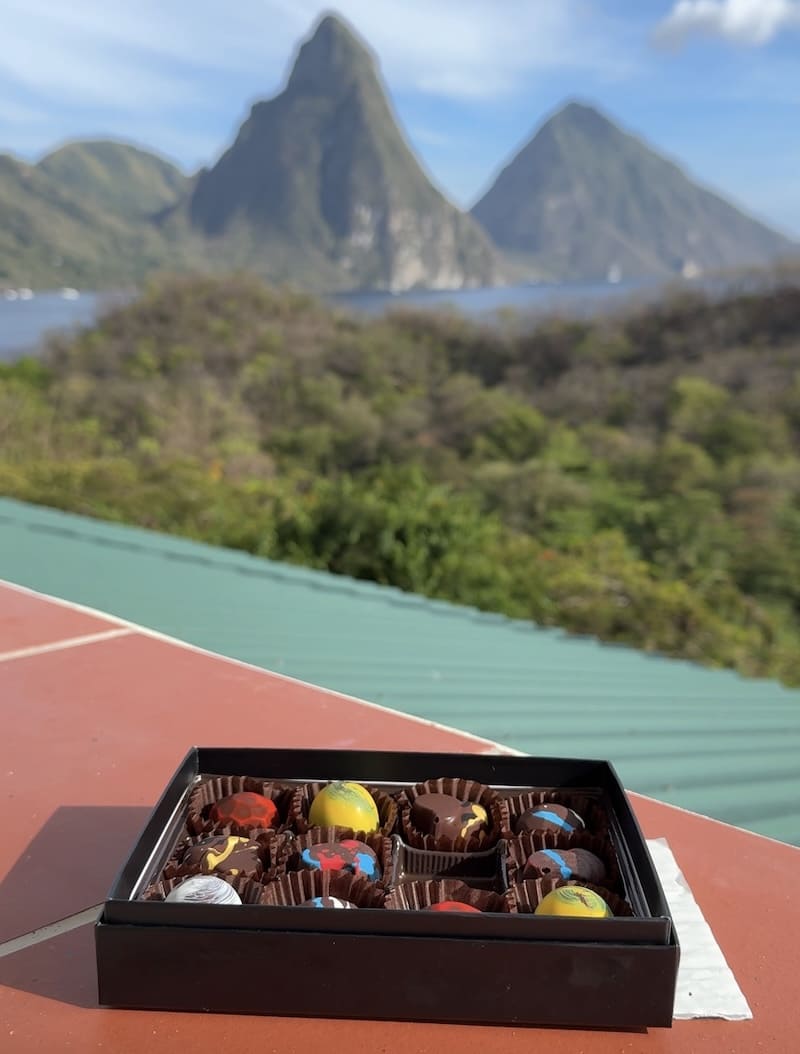
With our coffee pods in hand, we headed back to Jade Mountain, where resident chocolate master, Teron, took us into the on-site chocolate lab….and no words could begin to describe how the smell of roasting chocolate filled the room. In a small room using machinery they had to alter to work best for them along the way, the cocoa is brought fermented and dried from Emerald Estate to Jade to be roasted, winnowed, and ground to eventually make chocolate.
Cocoa has long been a primary export of Saint Lucia, but Anse Chastanet and Jade Mountain were the first on the island to both grow and process their own cocoa beans to make chocolate on-site. Since, others have started to do the same, but seeing the small batches that Jade produces their chocolate in speaks to the quality and care of the product. Now that you know a bit more about the process, be sure to look out for brands that not only can ensure quality, but also fair wages and treatment for those working along their entire supply chains.
Upon returning to our rooms, a few chocolate bars heavier and happier, we took a quick dip in our pool, and raced down to the beach where we would be setting off for our final excursion of the day.
Walking from Anse Chastanet beach to its neighbouring Anse Mamin beach takes no more than 10 minutes, and seemingly transports you to another landscape. The beach itself is wider, with a beach restaurant that sits along the edge of the historic Anse Mamin plantation. Once a sugarcane plantation turned fruit plantation, the grounds themselves have seen transformation, cruelty, and redemption over centuries of changes of ownership. We were told that there was no one better to show us this rich land than gardener Meno, who is known as ‘Father Nature’.
Walking with a big stick, used both to frequently draw diagrams in the sand as well as provide stability, Meno shared with us the history of the 600-acre plantation, on which the resort now partially sits along the other side of the bay, and shared anecdotes of his herbalist grandmother who passed away at 97 years old, and whose remedies, Meno believes, could cure anything from skin rashes to clouding eyes and organ dysfunction. Before plucking a leaf from a bush to share its scent or taste with the group, Meno would say, ‘May I have two leaves please, thank you!’ and although I’m sure others found it comical, we loved Meno’s deep knowledge and understanding that everything we take from nature must be given back or reciprocated.
.jpg)
.jpg)
.jpg)
Meno’s tour was one of the most insightful activities we partook in and one of our favourite parts of the trip. In addition to taking us into the ruins of the old sugar mill and teaching us a very honest history of the land and the people who worked it, we learned a lot about native and non-native plants and trees, and how they’re used around the island, too.
Sweaty from the humid rainforest, we spent the rest of the late afternoon snorkeling what’s called Turtle Reef just off Anse Chastanet’s beach. We heard sea turtles often nested there, but we didn’t expect to see the gentle creatures so quickly, with our first spotted right off the beach, nibbling some seagrass.
As we awoke on our last full day in St Lucia, we could barely comprehend how lucky we’d been throughout this trip, and how grateful we were to the Anse and Jade teams for making this trip one we would never forget.
After a quick morning snorkel once again in pursuit of spotting a sea turtle (which we did!), we had the pleasure of being invited to have lunch with the incomparable Karolin Troubetzkoy, owner of Anse Chastanet and Jade Mountain, and wife and business partner of architect Nick Troubetzkoy. Getting to hear her story of ending up in St Lucia from her native Germany, as well as how Nick’s vision evolved over the years was nothing short of incredible. She herself is and has been heavily involved in or presided over the evolution of Saint Lucia’s tourism board, coastal preservation initiatives, community empowerment schemes, and legislative changes surrounding creating laws that encourage more ethical and sustainable tourism practices.
If I accomplish half in my life of what Karolin has accomplished in hers, I will be very happy, and it was an absolute pleasure to walk the hiking and biking trails of Anse Mamin with her to witness her values, vision, and home first hand.
To wrap up the afternoon, we took part in a beachside art class. The canvases had a small pre-sketched drawing of the Pitons on them, but the rest was left up to us. Based on the otherworldly sunsets we had witnessed almost nightly on this trip, we decided to reach for the pinks, purples, and oranges, as well as deeper blues and greens to emphasise the reflections on the water.
.jpg)
.jpg)
.png)
Almost as if we had planned it, our final night at the resort happened to be both Ben’s birthday and the weekly beach barbecue, featuring favourite dishes from across the hotel’s menus and live music. As we ate our dishes piled high with vegetable fried rice, traditional St Lucian vegan bouillon, roasted vegetables, and cassava chips, we reflected on our six days in what seems like the happiest place on earth and how we could hope to one day create something that has such a positive impact on people, planet, and communities.
After we asked for the check, our reflections were cut short however by the steel drum band unexpectedly playing the tune of ‘Happy Birthday’, while our amazing server Rashida snuck up behind Ben with a chocolate cake filled with lit candles. Managers Peter Jean-Paul and Jonathan came over to sing to Ben and chat as the steel drums rang out their final notes, and everyone sitting under the tent cheered. We couldn’t have felt happier if we tried, to be honest.
Although we were both sad to be checking out and leaving Saint Lucia after six of the most incredible days of our lives, it didn’t feel final, as if it were a place we would never return to. The peace, joy, kindness, understanding, and knowledge that we found here on this resilient little island will stay with us, and hopefully guide us back here one day.
Taking one more plantain pancake for the road, we waved goodbye to the wonderful group of staff that came to send us off, climbed in the van and drove back down the winding road to the airport.
As we watched the soaring Pitons shrink in the distance, we fully understood what Nick Troubetzkoy saw and felt all those decades ago, when he spotted a dilapidated hotel on the mountainside ready for a new owner. Finding a hotel or experience that is truly great is not just about finding the most luxurious escape to tick off your bucket list, or even just the fact that you can find somewhere to unplug and get a little sunburnt. It’s the feeling of almost familiarity in a place you may have never been, reflected in the warm smiles of every member of staff as they proudly share where on the island they grew up or how their day is going. It’s in the stories told through food, through fabric, and through time spent together. It’s the feeling of home.
Follow along with us @goinggreenmedia, and be sure to visit @jademountainstlucia and @ansechastanet for more information.
For more green projects, inspiring people, and innovations working to save our planet, check out our socials!




The Going Green Media website was built with a low-carbon approach to design and development. We follow procedures to ensure that our digital footprint is minimal, and our mission for a greener future can be supported by the end user (that's you!).
This commitment starts with our minimal-load design. We optimise every element, compress every image, and use efficient styling and classes to minimise our code output. This planet-first approach decreases our digital footprint while creating a smoother user experience through less unnecessary data and faster load times.